
The Great Green Wall of Andhra Pradesh (GGW-AP) is a monumental coastal afforestation and climate resilience project spearheaded by Deputy Chief Minister Pawan Kalyan and the AP Forest Department. Designed to protect the state's vulnerable 974 km mainland coastline from devastating cyclones, storm surges, and sea erosion, this initiative replaces reactive disaster management with a proactive, nature-based "living ecological shield."
Inspired by Africa's Great Green Wall, the AP project establishes a 5-kilometer-wide multi-layered green belt extending from Srikakulam to Tirupati. By strategically planting hypersalinity-tolerant mangroves at the intertidal vanguard, tall casuarina trees as windbreaks, and dense economic agroforestry inland, the GGW-AP aims to restore 50% of the state's green cover by 2047. Funded through a convergence of MGNREGS, CAMPA, and international climate finance, the bio-shield actively safeguards the lives and livelihoods of 3.3 million residents living in high-risk coastal red zones.
Key facts
The programme at a glance, and the strategic framework behind it.
What is the Great Green Wall of Andhra Pradesh?
The Great Green Wall of Andhra Pradesh is a state-led coastal afforestation programme that plants a five-kilometre-wide belt of mangroves, casuarina and palmyra along 974 kilometres of shoreline from Srikakulam to Tirupati, shielding 3.3 million coastal residents from cyclones, storm surges and sea erosion.
Table 1 — Programme at a glance
| Coastline covered | 974 km mainland1,053 km including estuarine creeks |
|---|---|
| Belt width | 5 km50–200 m dense core on the shoreline |
| People shielded | 3.3 million Within the 5 km coastal red zone Press figure (33 lakh), print clipping only. See Sources. |
| Launched | 11 Sept 2025Bapatla, by Dy CM Pawan Kalyan |
| Green-cover target | 50% by 2047State-wide restoration goal |
| Palm-grove component | 5,499 hectares55 lakh palmyra seeds targeted |
| Mangrove standing | 2nd nationally MISHTI scheme, 2,047.70 ha in 2025–26 Departmental figure for 2025–26; not in the published PIB release. See Sources. |
| Funding route | ConvergenceMGNREGS, CAMPA, Green Credit, climate funds |
Strategic framework in detail
Key data points driving the coastal bio-shield implementation.
-
Continuous coastline
Runs the full length of the mainland coast, Srikakulam to Tirupati, as one continuous belt — the proactive alternative to the reactive, event-by-event disaster response described above.
-
Layered, not linear
Engineered as three distinct tiers, not a single tree line: a seaward mangrove-and-casuarina vanguard, a middle row that lifts wind up and over settlements, and an inland agroforestry canopy that absorbs what's left of the breeze.
-
Red-zone households
People already living inside the coastal red zone today — the same district list that recurs across the cyclone-landfall record further down the page, not a projected future risk.
-
Braided funding
What the answer box above calls "Convergence": employment-guarantee work, compensatory-afforestation levies, green credits and climate finance run as parallel budget lines behind one shelterbelt, not a single standalone scheme.
Table 2 — Expected ecological & economic ROI
| Return | What the belt delivers |
|---|---|
| Disaster reduction | Dampens storm surges and drops cyclone wind speeds before they hit towns. |
| Erosion control | Binds loose sand and severely reduces salt-water intrusion into freshwater aquifers. |
| Biodiversity | Restores ghost forests and creates massive estuarine nurseries for fish and birdlife. |
| Urban integration | Wraps industrial SEZs and ports in green buffers to filter airborne pollution. |
Why the wall exists
Nearly five decades of cyclone landfalls on the Andhra coast, and what each one exposed about the state's unprotected shoreline.
Table 3 — Recorded cyclone landfalls, 1977–2023
| Image | Year | Event | Where it struck | What it exposed |
|---|---|---|---|---|
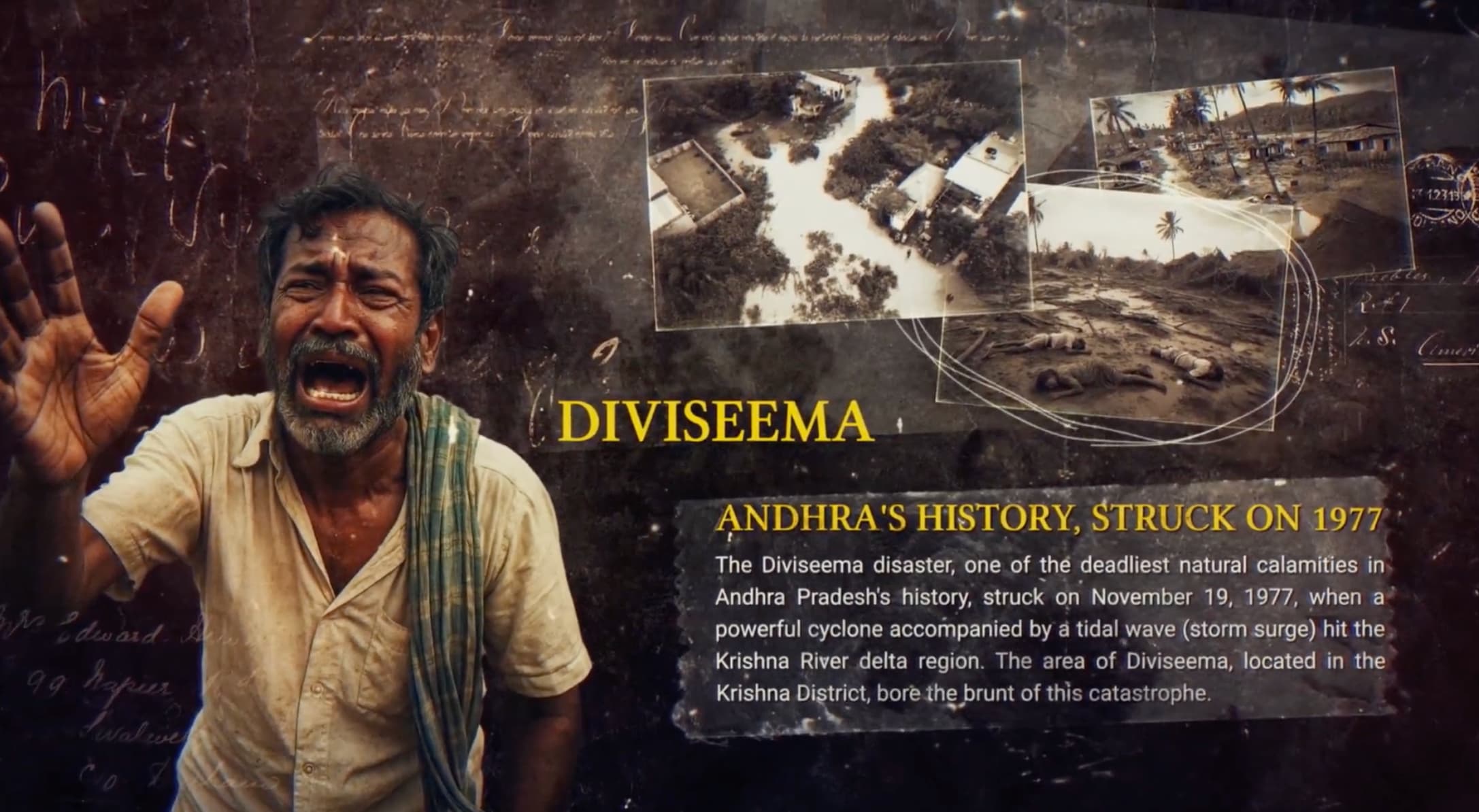 |
1977 | Diviseema Cyclone | Krishna River delta | One of the deadliest calamities in AP's history. A massive tidal wave and storm surge permanently altered the delta landscape. |
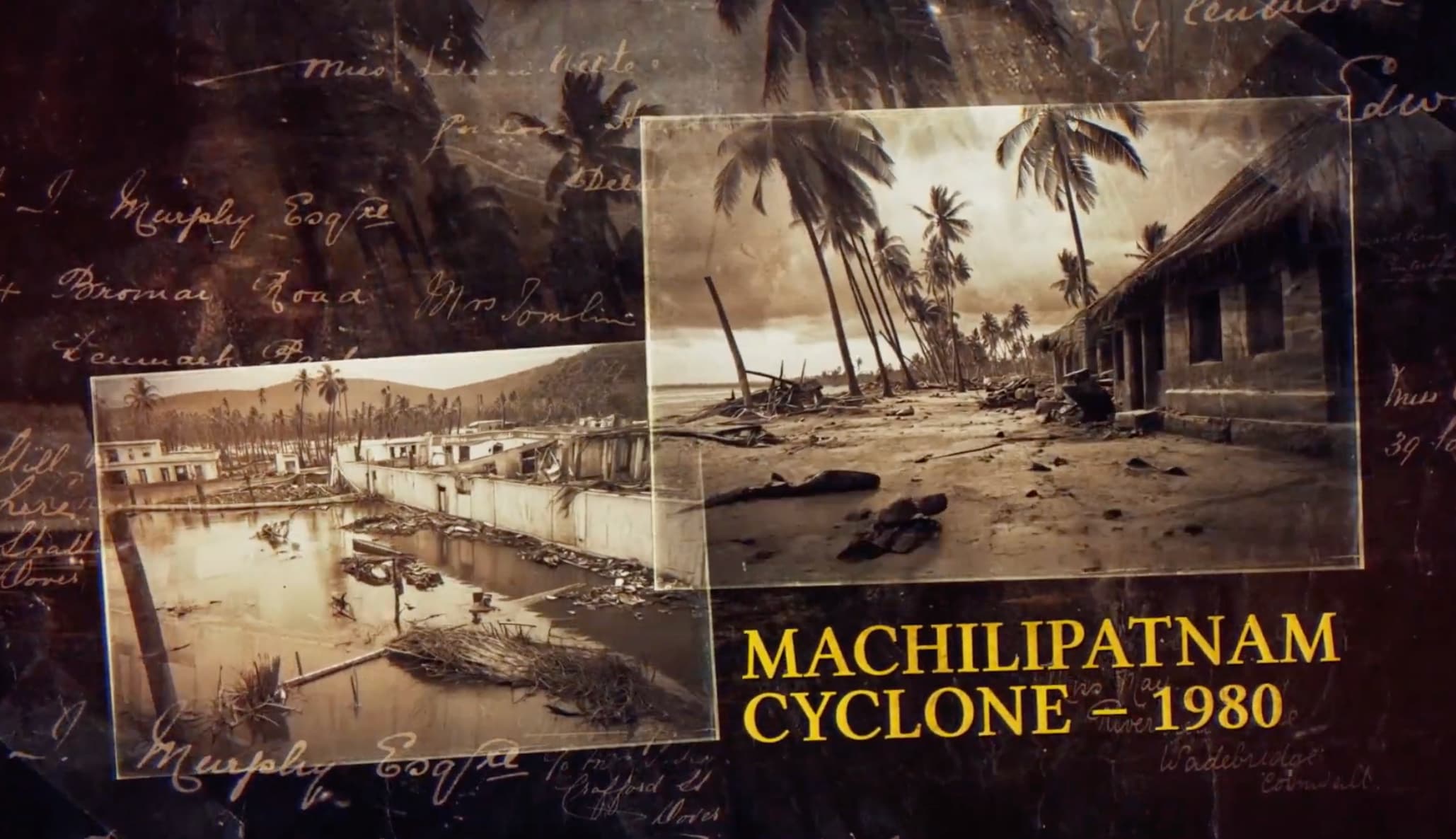 |
1980 | Machilipatnam Cyclone | Krishna district | Confirmed the Krishna district coastline's extreme vulnerability to recurring oceanic storms. |
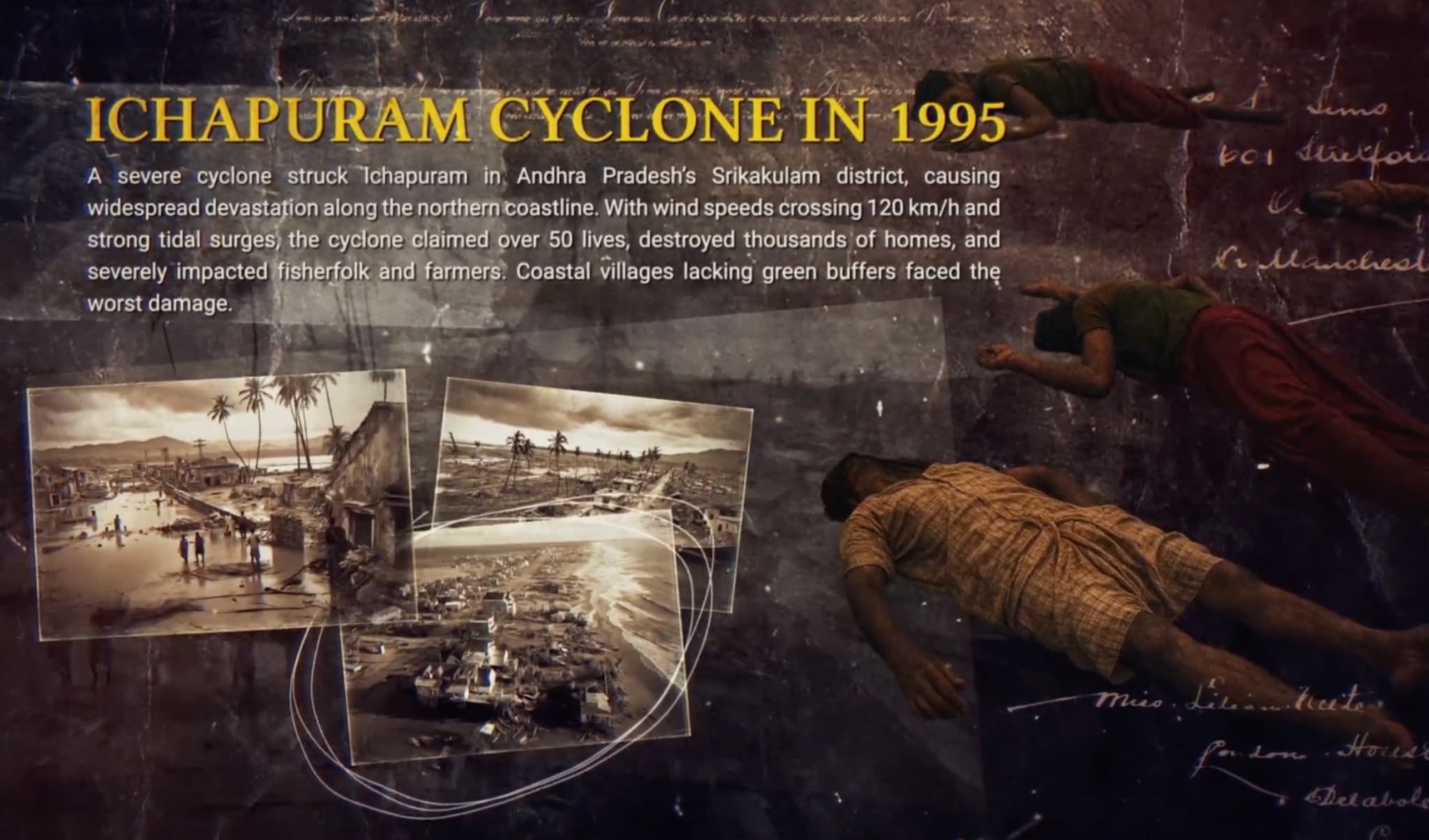 |
1995 | Ichapuram Cyclone | Srikakulam | Widespread devastation in Srikakulam district: over 50 lives lost and thousands of homes destroyed in coastal villages lacking green buffers. |
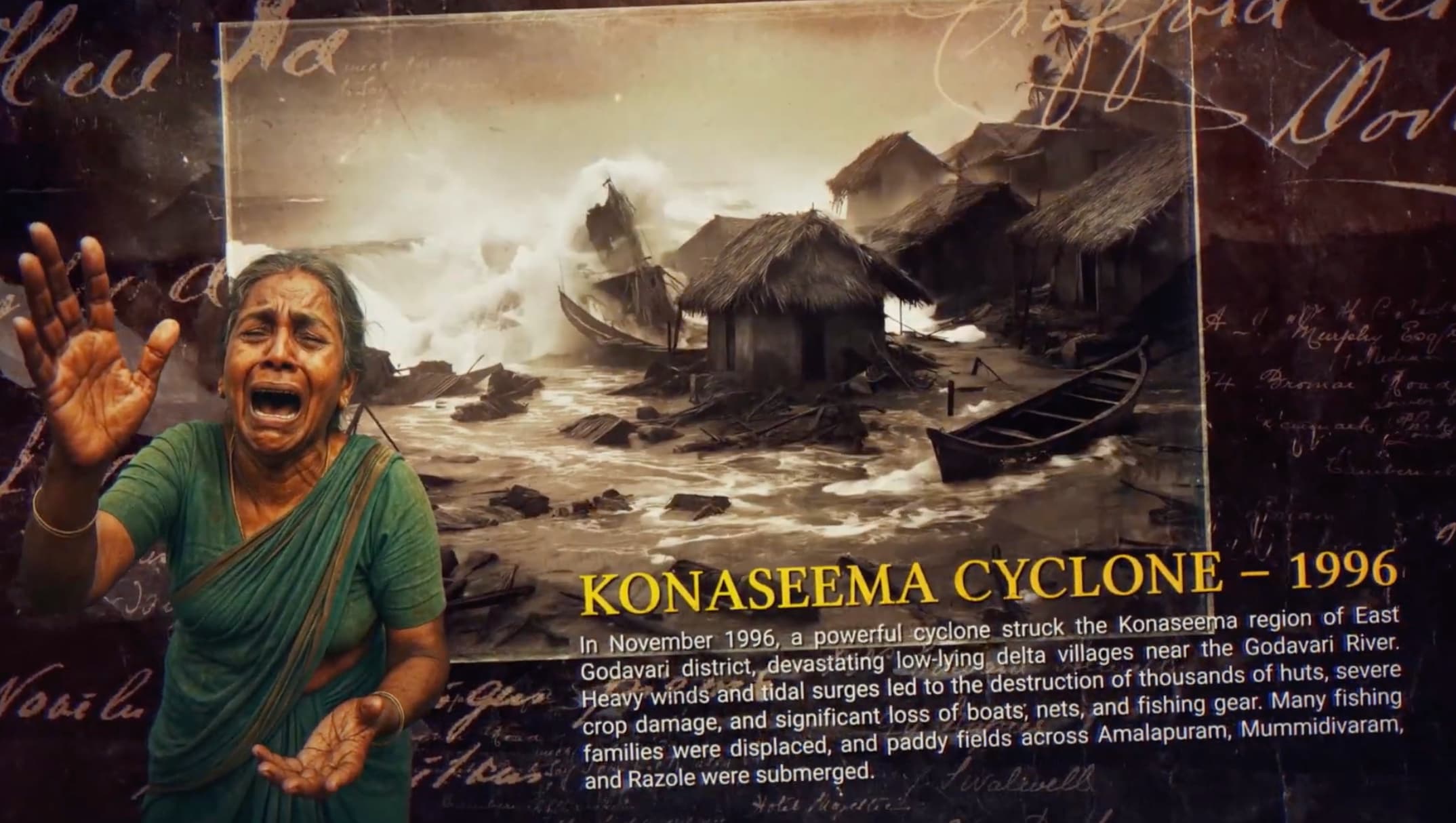 |
1996 | Konaseema Cyclone | Godavari River delta | Devastated the Konaseema delta region and its dense agricultural settlements. |
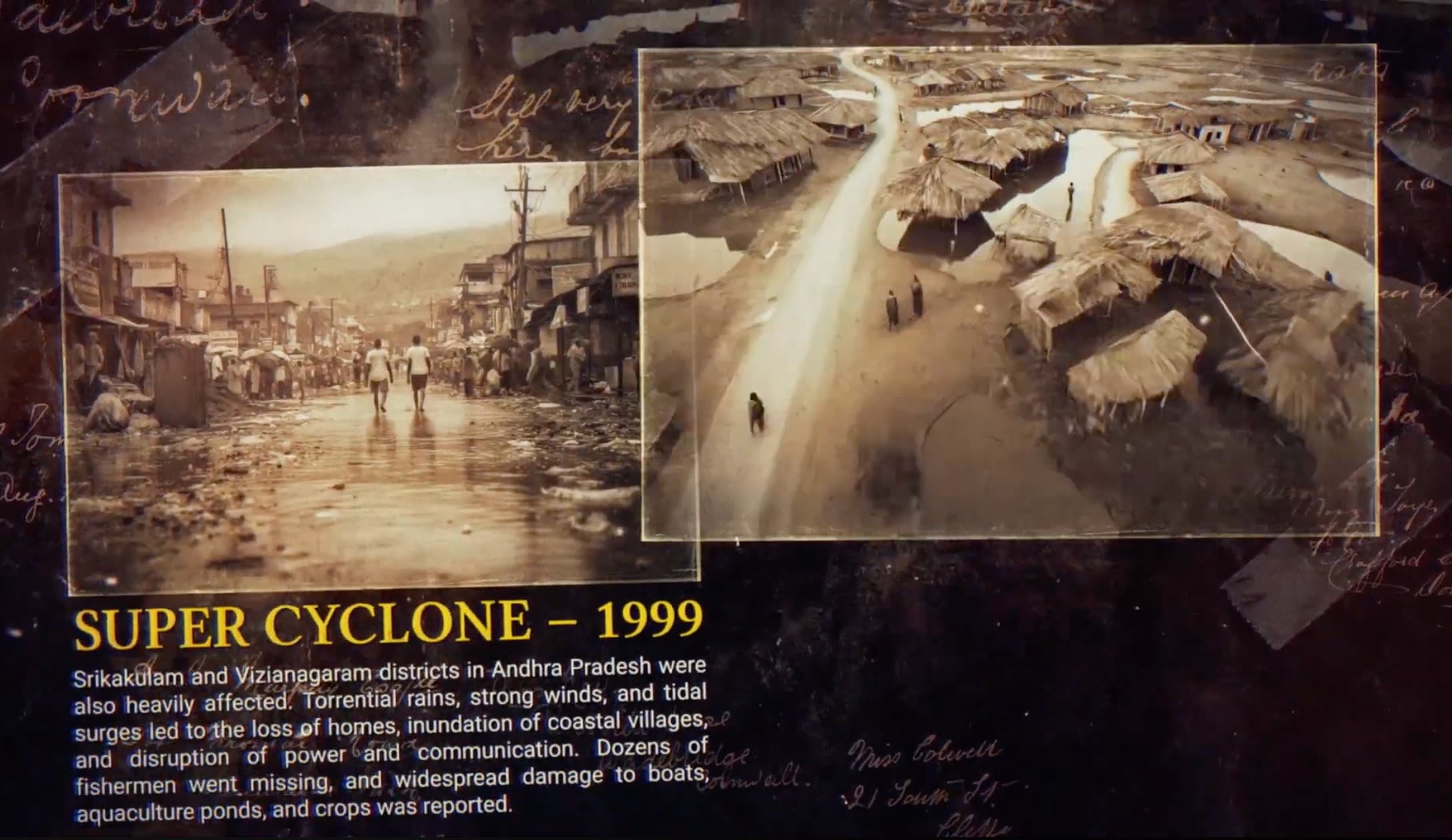 |
1999 | Super Cyclone | North coastal AP | Torrential rains and tidal surges inundated coastal villages, damaging boats, aquaculture ponds, and crops. |
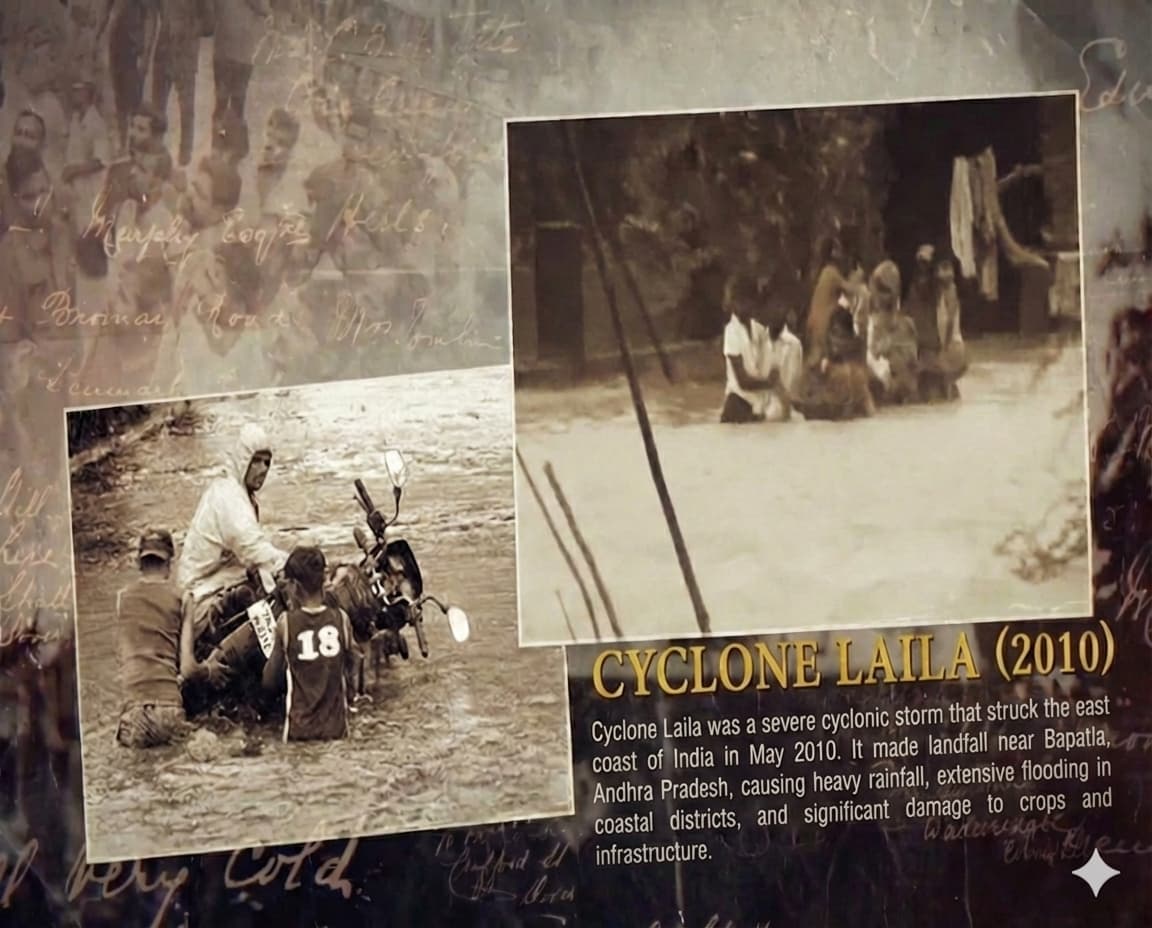 |
2010 | Cyclone Laila | Bapatla | First severe cyclonic storm to hit AP in over a decade, causing significant flooding across Krishna, Guntur, and East Godavari districts. |
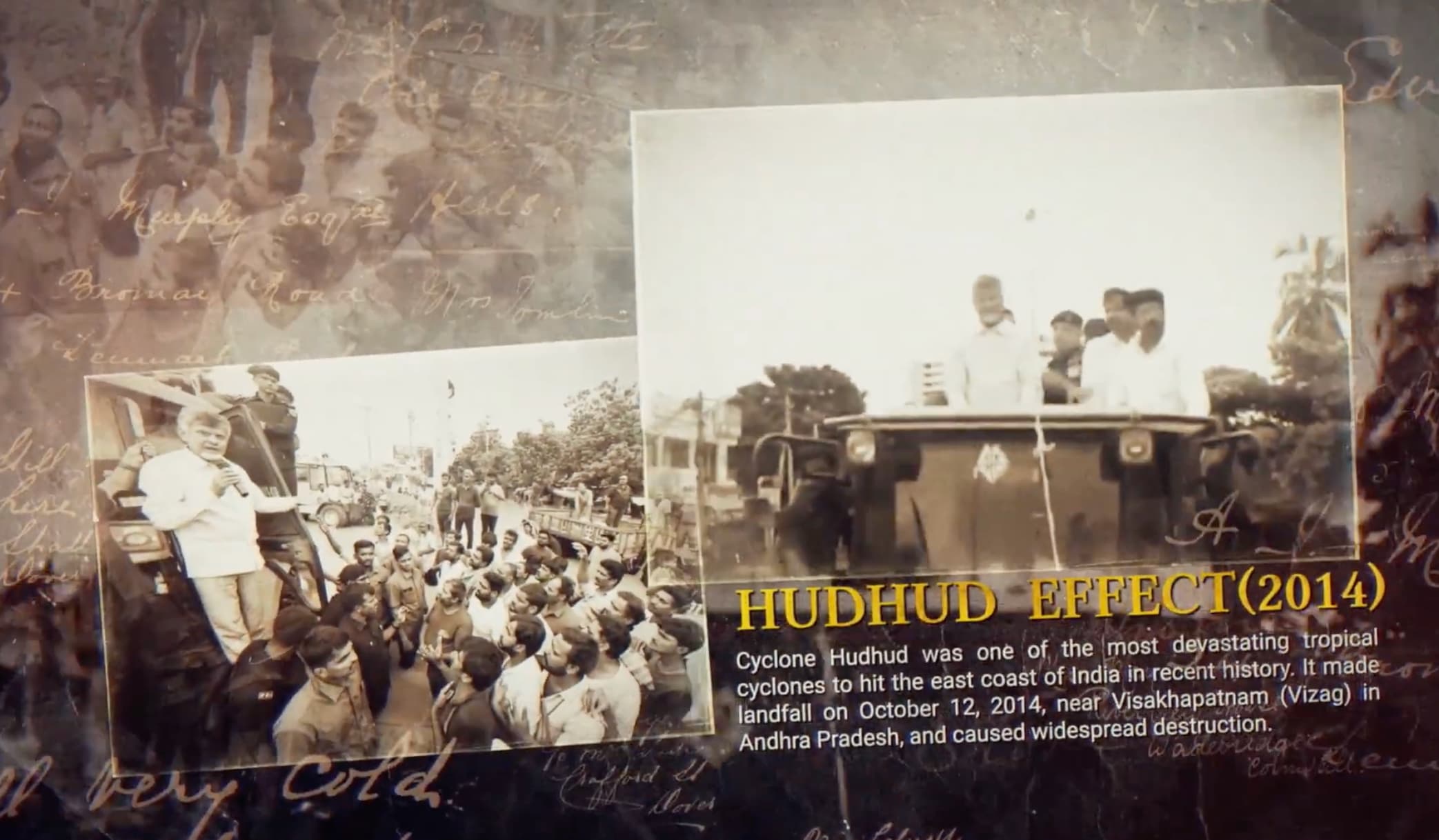 |
2014 | Cyclone Hudhud | Visakhapatnam | Direct landfall near Visakhapatnam caused unprecedented urban and infrastructure destruction across the coast. |
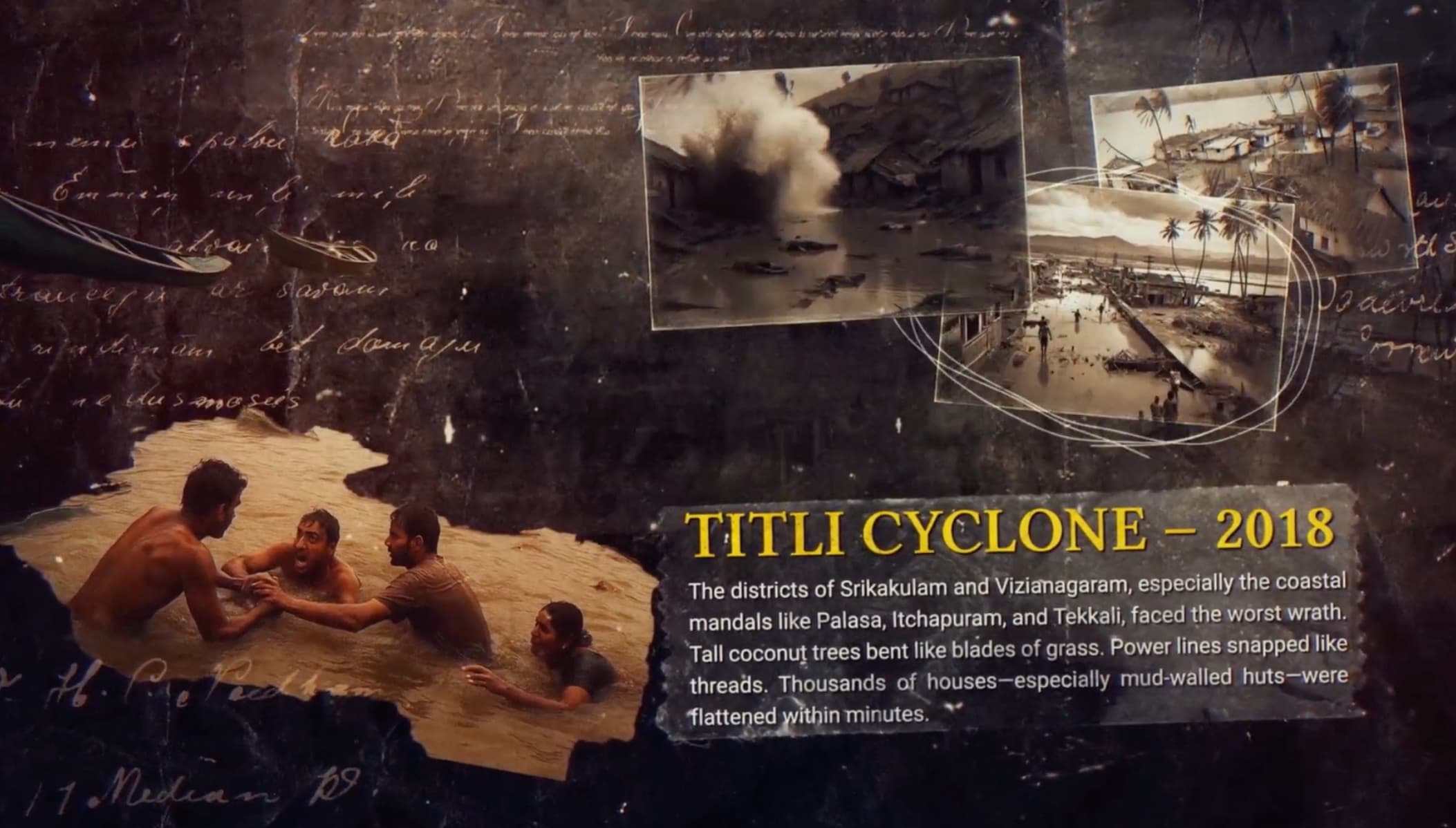 |
2018 | Cyclone Titli | Srikakulam | Flattened thousands of homes, especially mud-walled huts, within minutes across Srikakulam and Vizianagaram. |
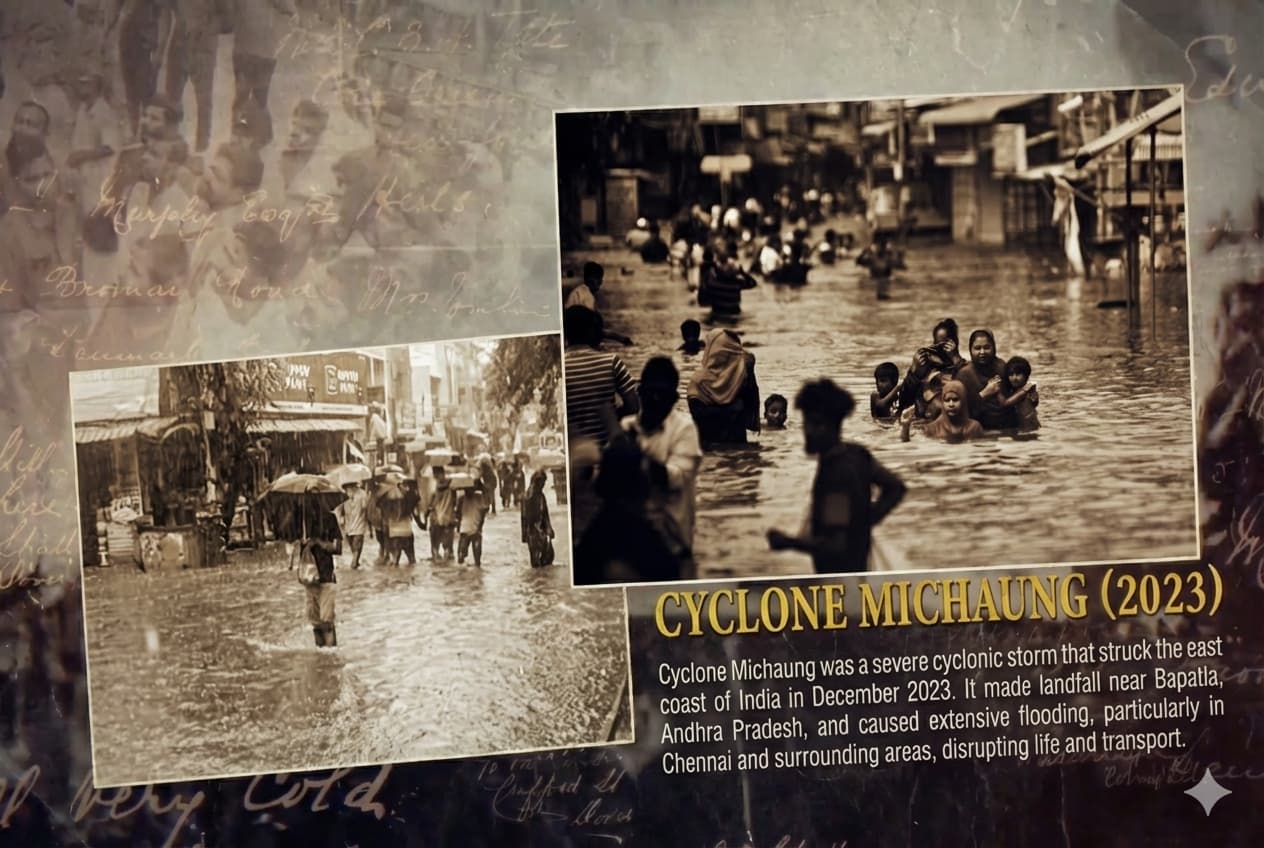 |
2023 | Cyclone Michaung | Bapatla | Severe flooding that exposed ongoing coastal erosion and directly accelerated the push for the GGW-AP. |
Compiled from the cyclone record described in AP Forest Department and press material. See Sources. The thumbnails are designed summary cards, not documentary photographs of these events: each composites archival-style imagery with a written caption, and some include illustrated figures. Treat them as illustration, not as evidence of what any individual storm looked like.
Progress on the ground: from vision to ground reality
Tracking the GGW-AP's journey — from its official launch to large-scale plantation drives and national recognition.
Live timeline Last updated:
11 September 2025 · Bapatla
Official launch: Coastal Green Mission
Deputy CM Sri Pawan Kalyan officially launched the Coastal Green Mission from Bapatla, setting out plans to shield the state's whole coastline — 974 km of mainland shore from Srikakulam to Tirupati, or 1,053 km once estuarine creeks are counted in — with mangroves, casuarina, and palm plantations as a natural barrier against cyclones and sea erosion.

26 October 2025 · Kondapavuluru
State-level workshop kicks off ground implementation
Dy CM @PawanKalyan convened a state-level workshop of forest officers at Kondapavuluru to finalize the on-ground rollout. Mangrove plantation and coastal afforestation along the 974 km mainland stretch, from Srikakulam southward, were mapped out to strengthen coastal ecosystems and safeguard local communities.

January 2026 · reported by Eenadu, Amaravati
Forest Department formally initiates the corridor
The Telugu daily Eenadu (Amaravati edition) reported that the AP Forest Department had formally initiated the project, setting out an ecological corridor five kilometres wide along the length of the state's coast. The same report carries the coastal-exposure figures this page uses: roughly 33 lakh people living within five kilometres of the shore, 282 villages at risk from rising sea levels, about 32% of the coastline eroding, and some ₹2.25 lakh crore of losses to natural disasters in the state over thirty years.

Early 2026 · Sagar Nagar Beach, Visakhapatnam
A strong step towards a greener coastline
Guided by the GGW-AP vision, the Forest Department commenced large-scale Palmyrah seed dibbling at Sagar Nagar Beach. 2,500 seeds were planted with Gayathri College students, Green Climate Team volunteers, Rotary Club and ActionAid members — part of a district-wide target of 1 lakh Palmyrah seeds across Visakhapatnam.


26 July 2026
National recognition2nd rank nationally under the MISHTI scheme
Andhra Pradesh secured 2nd place among Indian states under the Centre's MISHTI (Mangrove Initiative for Shoreline Habitats and Tangible Incomes) scheme, after developing 2,047.70 hectares of mangrove plantations in 2025–26 with an investment of ₹18.04 crore. The department's innovative Fish Bone Technique improved tidal water circulation and mangrove survival rates, with a further 1,618 hectares targeted for 2026–27.
25 August 2026
Palm groves: a natural green shield takes shape
As the second line of defence behind the mangrove belt, palmyra palm groves are being planted across a 5,499-hectare target using roughly 55 lakh seeds — reducing coastal erosion, acting as a windbreak against cyclones, and supporting biodiversity. Government departments, students, and local communities have already gathered 13 lakh seeds and planted 1.65 lakh saplings, as reported by The Hindu.

This timeline is updated as official milestones are announced. Exact date pending confirmation for the Sagar Nagar Palmyrah dibbling drive — placed here in approximate chronological sequence.
Structural zonation matrix
How the belt is arranged, tier by tier, from the intertidal zone inland.
The GGW-AP bio-shield is described as a multi-row plantation matrix rather than a random assortment of trees: a 3-tier arrangement calibrated to break wind velocity and trap salinity. The tiers below set out that standard shelterbelt logic as it applies to this coast; no departmental design document has been published, so the row-by-row detail is general shelterbelt practice, not a plan we can cite.
The seaward vanguard
The absolute first line of defense located directly in the intertidal zone and beach crests. Its primary mechanical goal is to absorb sheer tidal energy, trap moving sediment to halt beach loss, and block the initial assault of gale-force winds.
Deployed species
- Avicennia marina (Mangroves): Thrive in hypersalinity, their dense root systems act as physical sea-walls.
- Casuarina (Australian Pine): Planted on sandy crests; their needle-like foliage filters rather than blocks wind, preventing the trees from snapping.
1.glb could not be loaded. The mangrove intertidal and Casuarina crest zones are described in the text above.
The wind ramps (intermediate)
Positioned slightly inland along canal bunds and roadways. The aerodynamic goal of this layer is "Uplift"—forcing high-speed coastal winds up and over human settlements and agricultural tracts, while filtering out corrosive salt spray.
Deployed species
- Palmyra (Borassus flabellifer): Highly flexible, cyclone-resistant trunks.
- Bamboo & Silver Oak: Tall, straight-growing species that create a rapid upward ramp for air currents.
canal.glb could not be loaded. The intermediate wind-ramp layer is described in the text above.
The economic canopy buffer
Extending up to 5km inland, this final zone integrates disaster resilience with local economies. It creates a dense, year-round microclimate that slows the residual breeze reaching inland fields while providing harvestable goods for the community.
Deployed species
- Agroforestry Evergreens: Mango, Jackfruit, and Jamun. These provide heavy, dome-shaped canopies that establish a cool, humid zone, effectively protecting inland areas from dry heat and final wind drafts.
agro.glb could not be loaded. The inland agroforestry buffer is described in the text above.
Shelterbelt engineering matrix
A 3-to-5 row plantation strategy, row by row.
A 3-to-5 row plantation strategy intended to maximise wind deflection and protect inland communities. With appropriate setbacks from roads and buildings, each row serves a specific aerodynamic and defensive purpose. The species named in each row below are standard Indian shelterbelt choices drawn from the arid-zone review cited beside this matrix; they are not a published GGW-AP planting schedule.
Table 4 — Row structure, goal and species
| Row | Goal | Species |
|---|---|---|
| Outer row "The defense" |
The thorny barrier. Stops animals and breaks the initial force of ground-level dust and wind. |
Karonda (Carissa carandas): dense, thorny shrub; highly drought-tolerant. Bougainvillea: thick thorny mesh blocks ground wind. Mehndi (Henna): hardy bush that filters low-level dust. |
| Middle row "The uplift" |
The wind ramp. Tall, straight-growing species to "lift" the wind over inland fields and homes. |
Casuarina (Savukku): the #1 choice for coastal windbreaks. Silver Oak (Grevillea robusta): grows straight and tall quickly, lifting wind effectively. Bamboo: flexible wall that bends with the wind and pushes air currents upward. |
| Inner row "The shield" |
The year-round canopy. Creates a cool micro-climate and stops remaining breeze. |
Mango (Mangifera indica): dense, dome-shaped, year-round canopy that slows residual wind close to the ground. Jackfruit (Artocarpus heterophyllus): thick, leathery leaves impenetrable to drafts. Jamun (Syzygium cumini): creates a cool, humid zone beneath. |
shelter.glb could not be loaded. The row structure is described in full in the matrix above.
The biological arsenal
Deep-dive into the specific flora utilized to construct the wall.
Mangroves Avicennia marina
The ultimate coastal shock absorber. Studies indicate mature mangrove belts can reduce tsunami wave heights by up to 60%.
- Prevents severe coastal erosion.
- Acts as critical marine nursery.
man.glb could not be loaded.
Casuarina Australian Pine
Fast-growing, tall barriers planted on sandy shores. Their unique foliage whistles in the wind rather than snapping under pressure.
- Stabilizes loose sand dunes.
- Blocks highly saline winds.
c.glb could not be loaded.
Palmyra Toddy Palm
The state tree of AP. Incredibly resilient to hurricane-force winds due to its highly flexible trunk structure.
- Deep roots bind soil securely.
- High economic value for locals.
palm.glb could not be loaded.
Bamboo Bambusoideae
Planted along riverbanks and canals within the bio-shield. Dense clumps effectively break flood water velocity.
- Rapid regeneration rate.
- Vastly improves water infiltration.
bamboo.glb could not be loaded.
Global context: Africa's Great Green Wall
Where the idea comes from, and how the two walls differ.
The GGW-AP explicitly draws inspiration from the Great Green Wall of the Sahel. Launched in 2007 by the African Union, the African initiative aims to restore 100 million hectares of degraded land to combat desertification.
While the African wall fights the southward expansion of the Sahara Desert (Sand), the Andhra Pradesh wall fights the landward intrusion of the Bay of Bengal (Ocean/Salt). Both share the modern ecological philosophy of a "Mosaic" landscape—building integrated life systems rather than just planting uniform trees.
Table 5 — Scope compared
| Programme | Scope | Front |
|---|---|---|
| Africa — Great Green Wall of the Sahel | 8,000 km | Sand |
| Andhra Pradesh — GGW-AP | 974 km | Ocean |
Frequently asked questions
Direct answers to the questions most often asked about the GGW-AP.
What is the Great Green Wall of Andhra Pradesh?
Who launched the GGW-AP and when?
How long is the coastline the wall protects?
Which trees are planted in the Great Green Wall?
How is the GGW-AP funded?
How does it differ from Africa's Great Green Wall?
What progress has been made so far?
Sources & further reading
Figures on this page are attributed to the references below. Where a figure comes from a departmental communication or a print clipping that is not published online, it is marked as such where it appears rather than tied to a link here. Where a source reports a range or has been superseded, the most recent figure is used.
-
Parliamentary Question: MISHTI Scheme
Press Information Bureau, Ministry of Environment, Forest and Climate Change, 21 August 2025. Primary source for the MISHTI scheme itself and for the state-wise mangrove restoration areas reported to Parliament: Andhra Pradesh 137.26 ha in 2023–24 and 700.50 ha in 2024–25, 837.76 ha in total. This release does not cover the 2025–26 figures quoted elsewhere on this page, which are a later reporting period and are marked accordingly.
Government release -
Great Green Wall of Andhra Pradesh — Official Portal
Government of Andhra Pradesh. Primary source for programme scope, coastline length and the three-tier plantation structure.
Official portal -
Pawan Kalyan directs officials to speed up Great Green Wall project in Andhra Pradesh
The Hindu. Source for the launch of the Coastal Green Mission at Bapatla and the creek-inclusive 1,053 km coastline figure.
News report -
Great Green Wall: 5,499-hectare palmyra groves to form natural shield along Andhra Pradesh coast
The Hindu. Source for the palm-grove target, the 55 lakh seed requirement, and the 13 lakh collected / 1.65 lakh planted progress figures.
News report -
Shelterbelt and Windbreak Research in Arid India: A Review of Research Advances and Future Directions
Indian Journal of Agricultural Research. General multi-row shelterbelt principles from arid-zone research, applied on this page by analogy to a coastal, saline, cyclone-exposed belt. It is not a study of this coast and does not name the species listed in the engineering matrix.
Peer-reviewed research -
Deputy Chief Minister Pawan Kalyan — official account
Source for the Kondapavuluru state-level workshop and subsequent implementation announcements.
Primary statement -
Great Green Wall of Andhra Pradesh — press coverage
Eenadu (Telugu daily), Amaravati edition. Print clipping, reproduced in the timeline above; no online edition is available to link and the clipping carries no printed date. Source for the coastal-exposure figures: roughly 33 lakh (3.3 million) people within five kilometres of the coast, 282 villages at risk, about 32% of the coastline eroding, and ₹2.25 lakh crore of disaster losses over thirty years.
Print clipping — no URL
Appendix — material we cannot link
Some figures on this page come from material that has no public URL. Rather than attach them to a source that does not carry them, we name the material here and mark each figure where it appears:
- Departmental communications, 2025–26. The MISHTI ranking, the 2,047.70 ha and ₹18.04 crore figures for 2025–26, the Fish Bone Technique and the 1,618 ha target for 2026–27. Marked in the timeline and in the key-facts box.
- Eenadu, Amaravati edition — print clipping. The coastal-exposure figures: roughly 33 lakh (3.3 million) people within five kilometres of the coast, 282 villages at risk, about 32% of the coastline eroding, and ₹2.25 lakh crore of disaster losses over thirty years. The clipping carries no printed date and has no online edition we can link to; it is listed above as a print citation and reproduced in the timeline. Marked in the timeline and in the key-facts box.